
The Vertigenius™ Head Sensor is a medical-grade head kinematics sensor that provides clinicians with objective data after point-of-care consultations. Worn discreetly behind the ear and utilizing low-energy Bluetooth, it tracks real-time head kinematics during exercise to deliver immediate feedback to the patient.
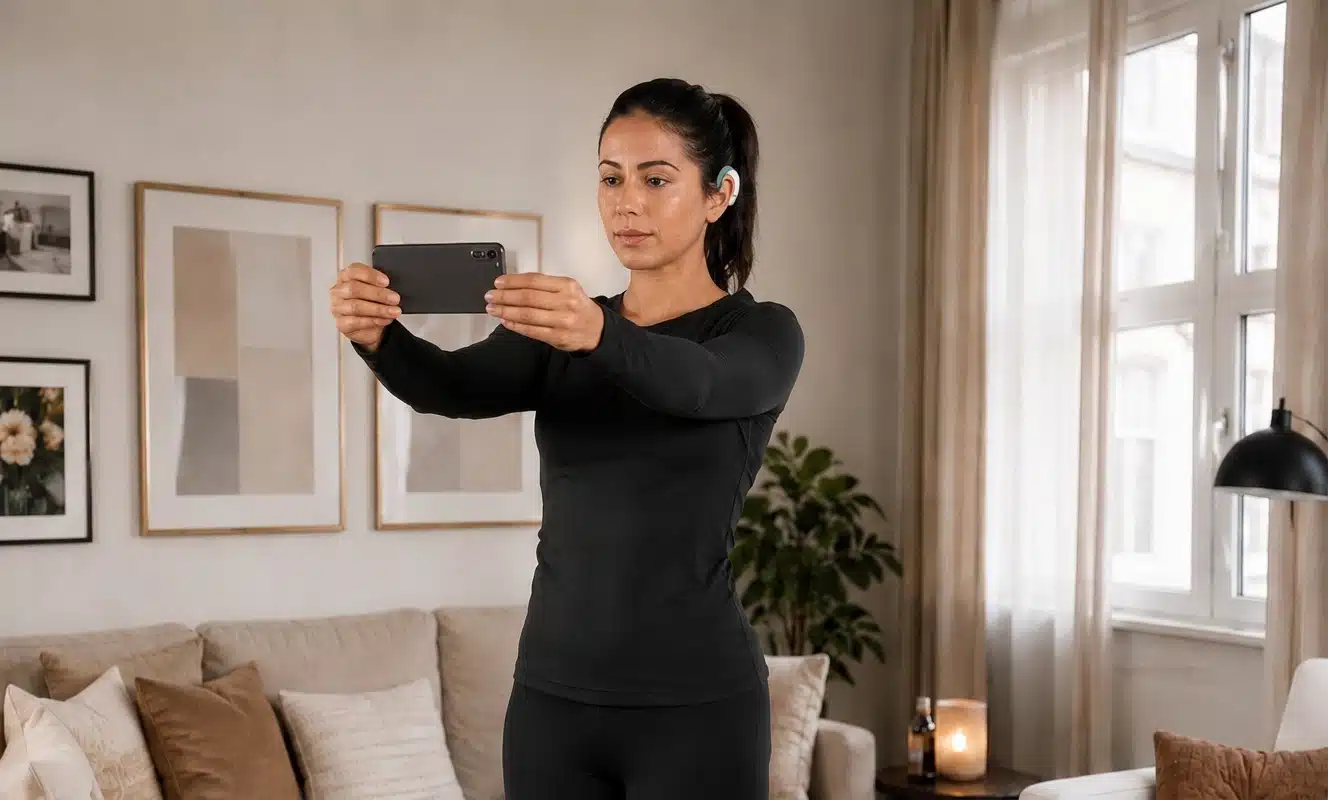
Home exercises are where vestibular rehab either starts to work properly or starts to fall away.
Patients forget the movement. They move too slowly, too quickly, or not quite as prescribed. And from the clinician side, there is often very little visibility into what is actually happening at home.
The Vertigenius™ Head Sensor helps close that gap. It adds measurable movement data to the rehab process, so patients get better guidance while clinicians get something more useful than a rough verbal update at the next appointment.
The sensor is designed to be practical in the real world. It fits just behind the ear, pairs with the patient’s smartphone, and can be used as part of the home programme without turning rehab into a technical exercise.
Connects via low-energy Bluetooth to the Vertigenius™ Patient App on iOS and Android. No extra hardware. No setup that gets in the way.
The sensor works alongside the app to provide immediate kinematic corrective feedback, guiding the patient to maintain the precise target velocity required for central nervous system compensation.
Tracks real-time angular velocity and head movement frequencies, providing the objective, quantitative datasets required to monitor Gaze Stabilization (VOR) and habituation progress.
The sensor is light, discreet, and worn just behind the ear. It charges quickly and stores enough power for a full week of typical home rehab.
Patients can put it on, pair it with their phone, and get on with the prescribed exercises — no setup that gets in the way.


Our platform offers a variety of specialised exercises crafted for vestibular therapy:
The value of the sensor is not just that it measures movement. It is that movement data feeds back into the wider Vertigenius™ platform, giving clinicians more visibility into adherence, performance, and progression over time.
Gaze stabilization (VOR)
Habituation tracking
Angular velocity
Head frequency
Published validation data demonstrates a statistically high correlation coefficient with diagnostic video Head Impulse Testing (vHIT) across therapeutic movement frequencies. The sensor provides validated accuracy for tracking angular velocity and head frequency during Vestibulo-Ocular Reflex (VOR) adaptation and habituation protocols, ensuring evidence-based clinical decisions.
The Vertigenius™ Head Sensor pairs natively via a secure, low-energy Bluetooth (BLE) protocol to any standard iOS or Android smartphone running our patient application. No additional external hardware or specialized baseline configuration is required.
The lightweight, ergonomic sensor clips securely and comfortably directly behind the pinna (ear). This placement optimizes the device's inertial sensors to capture true cranial motion and precise angular head velocities.
No. The sensor does not replace professional clinical diagnostic equipment like diagnostic vHIT setups or posturography. Instead, it serves as a Remote Therapeutic Monitoring (RTM) tool to capture home compliance and kinetic tracking data between clinical evaluations.
Yes. The sensor operates as the data-collection component of the unified 3-in-1 Vertigenius™ ecosystem, seamlessly transmitting home exercise performance and raw frequency metrics straight to the cloud-connected Clinician Portal.
The Head Sensor works alongside the patient app and clinician portal — together they form one connected approach to vestibular rehab.
The app pairs with the sensor over Bluetooth and turns movement data into real-time guidance during home exercises.
Sensor performance and adherence flow into the portal so you can review progress and adjust programmes between visits.
Understand how the sensor, app, and portal fit together as a single ecosystem for vestibular rehabilitation.
If you want a closer look at how Vertigenius™ supports remote monitoring in vestibular rehab, we can show you exactly how the sensor works in practice.