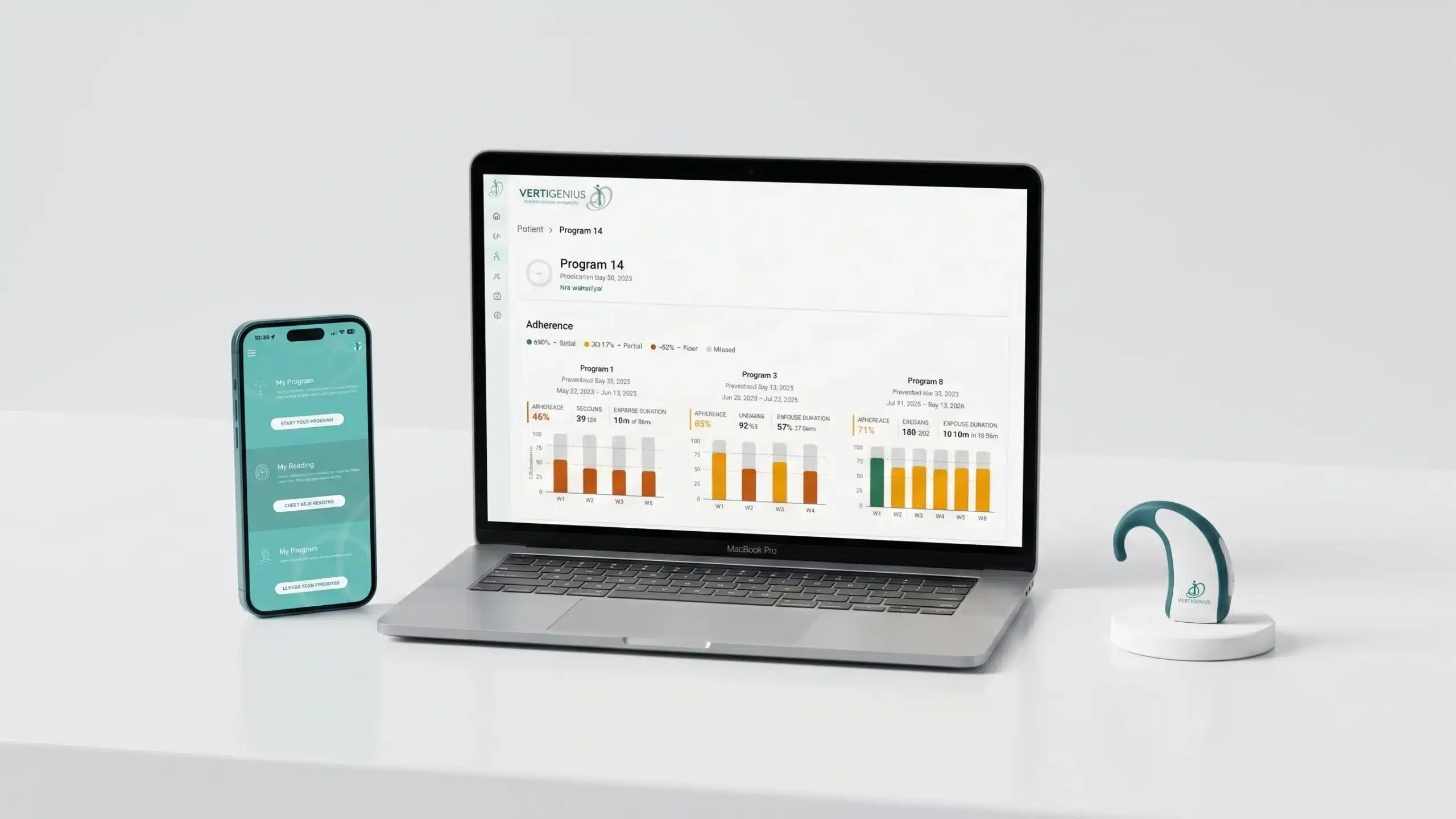
Vertigenius™ is an FDA registered and listed medical device and digital vestibular rehabilitation platform that connects clinicians and patients through a Clinician Portal, Patient App, and wearable Head Sensor.
Vertigenius™ captures objective head kinematic data from how patients perform their prescribed vestibular exercises, alongside exercise adherence and patient-reported symptoms. This gives clinicians a more complete picture of rehabilitation—not just whether a patient completed an exercise, but how they performed it and how much symptom provocation it caused.
With this combination of objective movement data, adherence, and symptom reporting, clinicians can monitor vestibular rehabilitation remotely and make informed adjustments to a patient’s personalised exercise programme based on how the patient actually performed and responded to each exercise.
By connecting exercise performance, adherence, and symptom response, Vertigenius™ extends vestibular rehabilitation beyond the clinic, giving clinicians greater visibility into the patient’s recovery between appointments and enabling more personalised, responsive, and measurable care.
3-in-1
Head Kinematics
Symptoms & Adherence
Adjust Between Visits
The Gap Between Prescription and Progress.
You assess thoroughly. You diagnose accurately. You prescribe a personalised vestibular rehabilitation programme.
Then your patient leaves the clinic.
From that moment on, you’re relying on memory, motivation and hope. Patients forget exercises, question whether they’re performing them correctly, lose confidence, or simply stop doing them consistently. Meanwhile, you have little or no visibility into what happens between appointments.
For clinicians, this creates a bigger challenge. Limited time and growing caseloads make it difficult to monitor every patient outside the clinic. Without meaningful insight into adherence and progress, follow-up appointments become reactive rather than informed, capacity remains constrained, and opportunities for sustainable practice growth are limited.
Vertigenius™ closes that gap.
It gives clinicians a smarter way to prescribe, manage and monitor vestibular rehabilitation, with visibility into patient engagement and progress beyond the clinic walls. Patients receive clear guidance, structured home exercise programmes and ongoing support where rehabilitation really happens—at home, in motion, and in everyday life.
The result is better patient adherence, more informed clinical decisions, greater clinic efficiency and the ability to deliver high-quality vestibular care at scale.
Vertigenius™ is built around three connected parts that work as one platform.
Build and prescribe personalised exercise programmes, document progress, and keep track of how each patient is getting on without relying on guesswork.
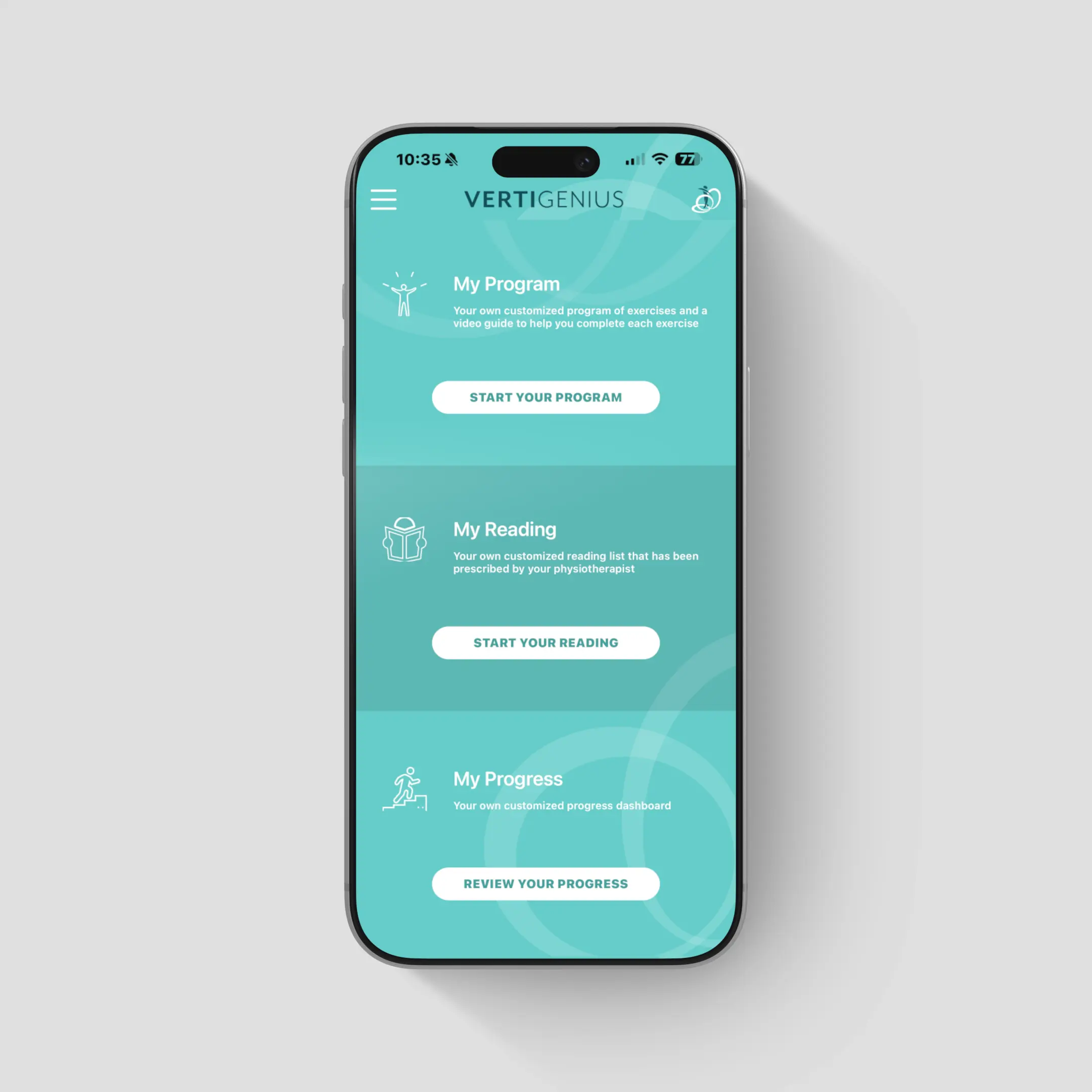
Patients receive their exercises, follow guided instructions, and work through rehab with clearer support between appointments.
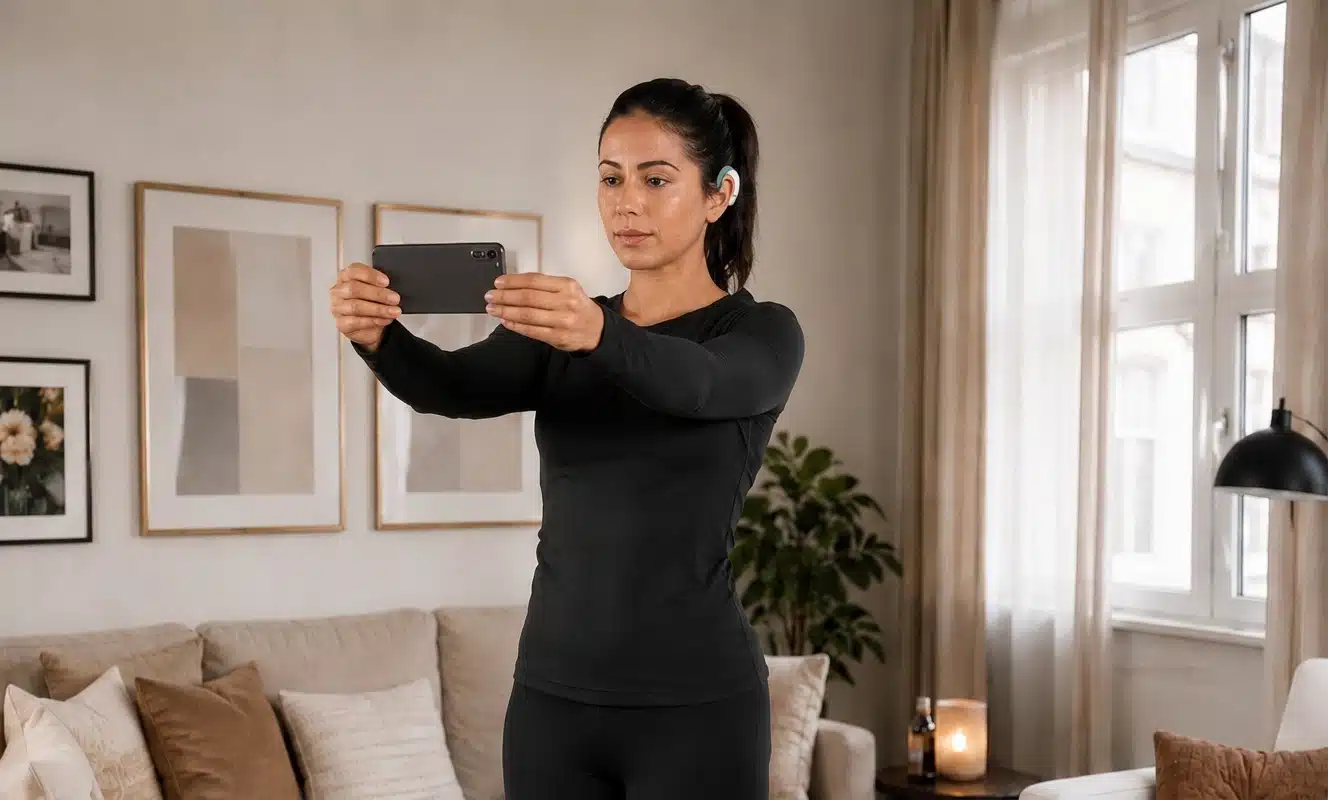
A small sensor worn behind the ear connects to the patient's phone and measures head movement during exercises, turning home rehab into something more trackable and precise.
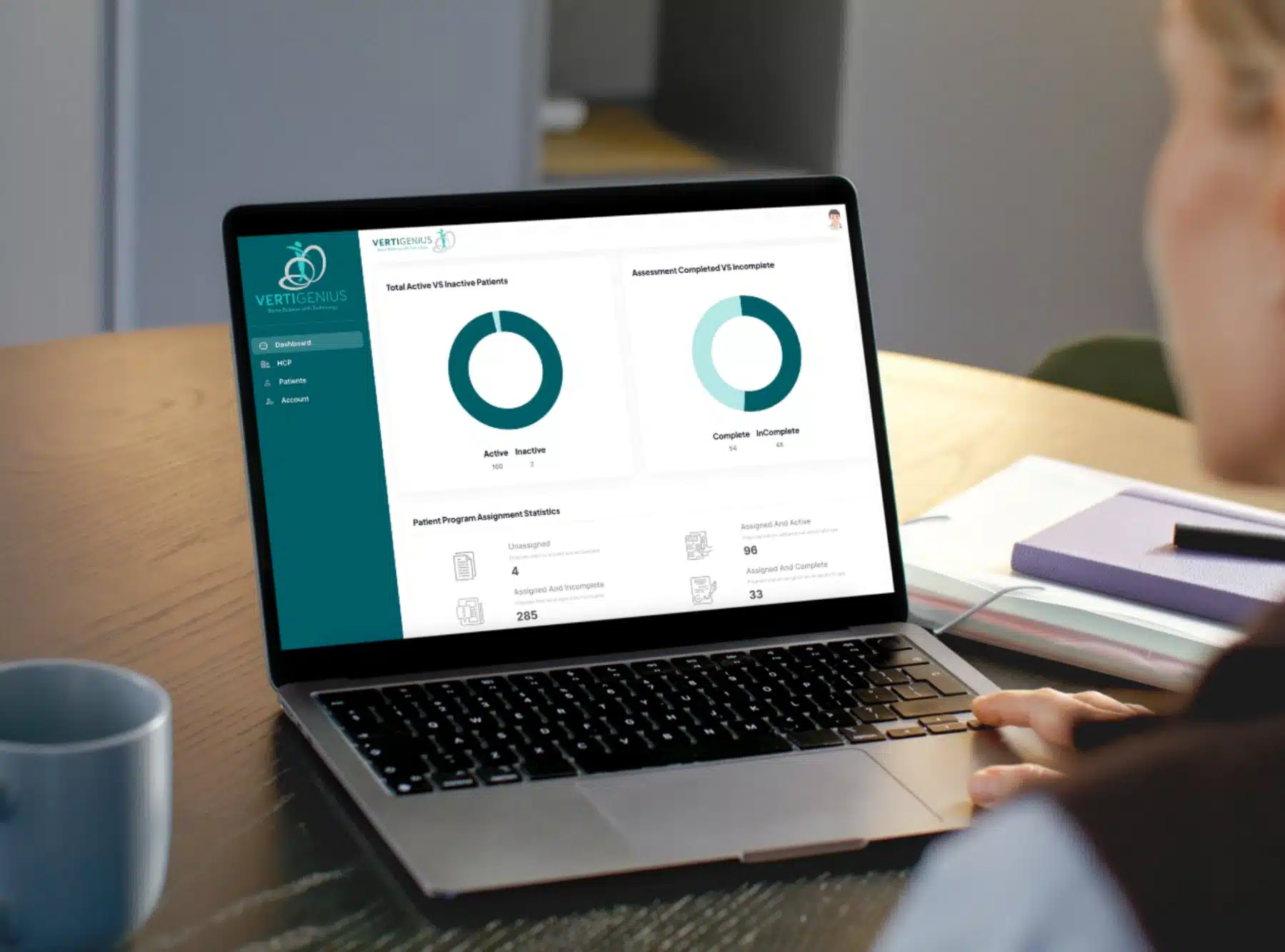
The Vertigenius™ Clinician Portal streamlines vestibular rehabilitation by giving you one place to assess patients, prescribe personalised exercise programmes, monitor progress, and manage care between appointments.
Create individualised rehabilitation plans based on each patient’s presentation. Modify exercises as symptoms change, review progress over time, and share educational resources that reinforce your treatment plan.
With greater visibility into patient adherence and recovery outside the clinic, every follow-up becomes more informed, every appointment more productive, and every clinician better equipped to deliver high-quality vestibular care – without adding complexity to the clinical workflow.
Most patients are not struggling because they do not care. They are struggling because home rehab can be hard to remember, hard to judge, and easy to drift away from.
The Vertigenius™ app helps bring some clarity back. Patients can log in securely, see what they need to do, and work through prescribed exercises with a better sense of direction.
They are not left trying to recall a half-remembered explanation from last week. The app keeps the plan in front of them.
The head sensor adds something most home programmes never have: measurable movement data.
It connects to the patient’s phone by Bluetooth and tracks
head movement during exercise, providing patients with
immediate corrective feedback while giving clinicians a more useful view of performance, progress, and adherence over time.
Real-world case studies demonstrating improved adherence, faster recovery, and measurable patient outcomes.
Select a study to view its outcomes.
Primary Focus
Usability and clinical outcomes in Multiple Sclerosis (PwMS).
System Usability (SUS)
81/100 (High usability).
Patient Enablement (PEI)
Mean score 5.8/12; 75% felt better able to understand their illness.
Dizziness & Vertigo
Significant reduction in NRS Dizziness scores (p=0.002).
Balance & Gait
Significant improvements in Mini-BESTest (p=0.004) and mDGI (p=0.008).
Visual Stability
Significant improvement in Dynamic Visual Acuity (DVA) (p=0.004).
Adherence Tracking
Mean adherence: 60.1% (measured digitally).
Remote Care Facilitation
64.5% of follow-ups conducted via telehealth.
Safety
No treatment-related adverse effects.
Primary Focus
System Usability (SUS)
Patient Enablement (PEI)
Dizziness & Vertigo
Balance & Gait
Significant reduction in perceived imbalance (p<0.002).
Visual Stability
Adherence Tracking
Remote Care Facilitation
Safety
No adverse events recorded.
A short walkthrough showing how the sensor pairs, wears, and feeds back to the patient and clinician.

The strength of the platform is not any one feature on its own. It is how the pieces support each other.
The clinician portal makes prescription and review easier.
The app helps patients stay oriented and engaged.
The sensor adds an extra layer of objectivity during home rehab.
Together, that creates a more connected treatment experience. One that is easier to deliver well and easier to stick with.
Explore the streamlined process of Vestibular Rehabilitation with Vertigenius™ through our “How it Works” section.
Effortlessly conduct and document key vestibular outcome measures, including Dynamic Visual Acuity (DVA), Balance Tests, and Gait Speed using Vertigenius™
Access a library of 400+ specialist-led exercises to build customized, high-adherence Vestibular Rehabilitation Therapy (VRT) and balance home exercise programs.
Leverage advanced Remote Therapeutic Monitoring (RTM) technology to observe patient data outside traditional healthcare settings.
Vertigenius™ was developed specifically for vestibular rehabilitation, backed by peer-reviewed scientific usability data. Published studies confirm excellent platform usability for both clinicians and patients, with studies demonstrating statistically significant improvements in patient symptom reduction and functional balance outcomes. “Toward a Digital Health Intervention for Vestibular Rehabilitation: Usability and Subjective Outcomes of a Novel Platform” – 2022
A better setup
Better visibility
More practical support
If you want a better way to prescribe, deliver, and monitor vestibular rehab, Vertigenius™ is built for exactly that.
The Vertigenius™ head sensor utilizes integrated motion sensors to track real-time head movements via Bluetooth. It provides immediate corrective feedback to the patient app during home exercises and delivers precise data directly to the clinician portal.
Yes. Vertigenius™ is an FDA Class II medical device in the USA and is certified as an MDD Class 1 Medical Device in Europe. The entire ecosystem is fully HIPAA and GDPR compliant to ensure maximum patient data privacy.
Absolutely. The clinician portal contains a library of over 400+ specialist-led vestibular exercises, allowing healthcare providers to build, adjust, and monitor highly individualized home care plans based on real-time data.