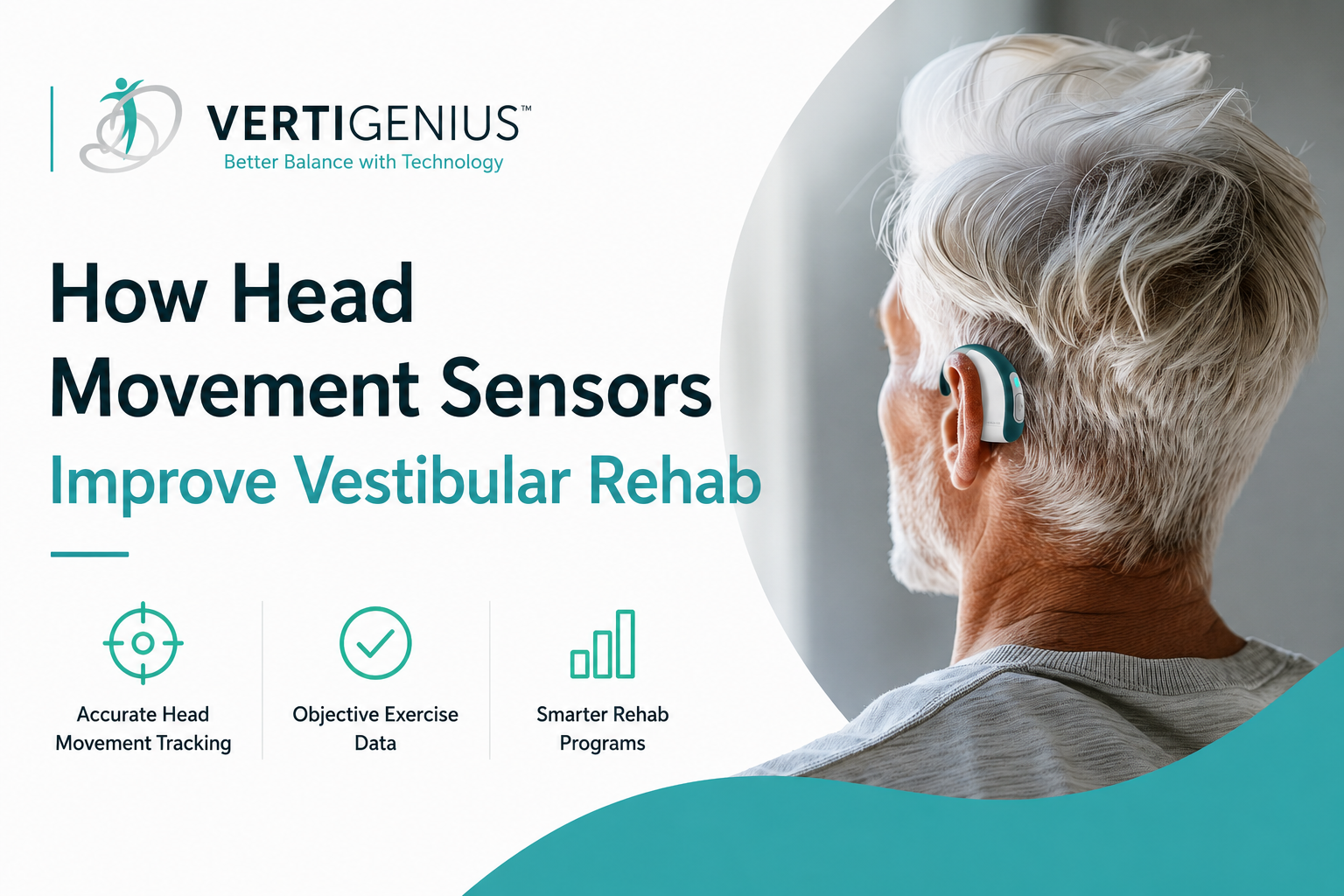
Discover how wearable head movement sensors enhance vestibular rehabilitation outcome measurement, track patient adherence, and optimize clinical response.
For clinicians treating dizziness and balance disorders, tracking patient progress has traditionally relied on a combination of clinical observation, standardized functional scales, and patient self-reporting. While valuable, these tools often leave a gap when evaluating home exercise performance, precise movement kinematics, and real-time treatment response.
The integration of head movement sensors for vestibular rehabilitation is transforming clinical practice. By providing objective, quantitative data on head velocity, frequency, and range of motion, wearable technology bridges the gap between clinic visits and home exercise programs.
Key Takeaways
-
Objective Kinematic Data: Wearable sensors capture precise velocity, acceleration, and range of motion during gaze stabilization (VOR) and habituation exercises.
-
Adherence and Response Tracking: Real-time vestibular rehab data tracking enables clinicians to verify home exercise execution, duration, and movement quality rather than relying solely on memory.
-
Enhanced Outcome Measurement: Quantitative insights refine vestibular rehabilitation outcome measurement, supporting individualized treatment progression and faster clinical decision-making.
-
Data-Backed Practice: Sensor metrics provide solid evidence for outcome research and reimbursement requirements.
The Challenge of Objective Measurement in Vestibular Care
Vestibular rehabilitation therapy (VRT) relies on driven neuroplasticity—specifically adaptation, habituation, and substitution. Achieving optimal outcomes requires patients to perform targeted exercises, such as Vestibulo-Ocular Reflex (VOR) x1 and x2 training, at specific speeds and frequencies.
Traditionally, clinicians face two primary challenges:
-
In-Clinic Subjectivity: Assessing head movement speed visually during clinical tests can make it difficult to quantify micro-progressions over time.
-
The “Home Exercise Black Box”: Patient compliance logs often fail to accurately capture whether exercises were performed at the prescribed target velocity or target dosage.
Integrating wearable head trackers solves both challenges by converting subjective movement observations into clear, actionable data.
How Head Motion Tracking Enhances Clinical Outcomes
1. Direct Kinematic Feedback
Precision head motion tracking allows clinicians to measure exact parameters during exercise execution:
-
Head Velocity (deg/sec): Critical for ensuring the head moves fast enough to challenge the VOR without exceeding patient tolerance.
-
Movement Symmetry: Detecting compensatory strategies, such as asymmetrical head turning or improper axis movement.
-
Target Frequency & Duration: Monitoring sustained performance across balance and habituation sets.
2. Differentiating True Progress from Compensation
When patients show clinical improvement, it is vital to know why. Did their vestibular function adapt, or did they simply reduce their head speed to avoid symptoms? Head movement sensors for vestibular rehabilitation reveal whether a patient is moving faster with fewer symptoms or secretly limiting their movement to stay within a comfortable zone.
3. Clearer Vestibular Rehabilitation Outcome Measurement
Combining standardized clinical outcome measures (such as the Dizziness Handicap Inventory or Functional Gait Assessment) with sensor-derived metrics creates a comprehensive picture of recovery. Clinicians can track baseline movement speed against post-treatment parameters, providing tangible proof of recovery to both patients and referring physicians.
Evaluating Patient Adherence and Treatment Response
One of the greatest predictors of success in vestibular rehabilitation is consistent, accurate home exercise performance. Sensor-based platforms transform how clinicians monitor patient progress remotely:
-
Adherence Verification: Wearable sensors log exact exercise timestamps, duration, and head movement repetitions, providing complete transparency regarding home program completion.
-
Symptom-Movement Correlation: Tracking head speed alongside patient-reported symptom scores highlights which specific head velocities trigger dizziness or nausea.
-
Timely Prescription Adjustments: Clinicians can modify exercise frequency, velocity targets, or complexity based on objective trends rather than waiting for the next scheduled appointment.
Rehabilitation Clinic Sensor Selection: What to Look For
Choosing the right technology for your clinic requires evaluating both hardware performance and clinical workflow integration. Key factors in rehabilitation clinic sensor selection include:
| Feature | Clinical Significance |
| Accuracy & Sampling Rate | High-frequency tracking ensures precise capture of high-velocity head movements without signal lag. |
| Patient Ergonomics | Lightweight, non-intrusive form factors ensure patient comfort and ease of put-on/take-off for all age groups. |
| Software Analytics | Intuitive dashboards that translate complex sensor data into actionable clinical metrics and simple patient-facing progress graphs. |
| HEP Integration | Seamless synchronization between in-clinic testing, home exercise software, and remote data collection. |
Advancing Outcome Research in Vestibular Care
The widespread adoption of wearable head trackers benefits individual clinics while advancing outcome research across the broader field of vestibular rehab and neuro-otology. Aggregate sensor data helps establish standardized benchmarks for recovery across various etiologies—including vestibular neuritis, BPPV residual dizziness, persistent postural-perceptual dizziness (PPPD), and concussion management.
By contributing to a growing body of quantitative outcome data, audiology and physiotherapy clinics can demonstrate treatment efficacy to health networks, insurers, and medical colleagues.
Transform Your Vestibular Practice with Vertigenius™
The era of relying solely on subjective self-reports for home vestibular exercise is giving way to data-driven precision care. By introducing head movement sensors into your clinical workflow, you empower your patients with clear feedback while equipping your team with the data necessary to optimize care plans.
Vertigenius™ offers clinicians an integrated platform designed specifically for vestibular assessment and rehabilitation. Combine wearable sensor technology, custom home exercise software, and continuous data tracking to elevate your patient experience.
Interested in exploring how head movement sensors can enhance your clinic? Schedule a Vertigenius™ demonstration today.